
A recent Capitol Hill hearing featured warnings that the United States is losing its grip on energy innovation. Union leaders, including a local IBEW leader, urged lawmakers to reverse course and invest in the projects – and jobs – that will power the future.
Yes but. Labor-friendly members of Congress remain locked out of power and unable to change course on Republican energy policies that have cancelled projects and targeted wind and solar specifically.
“Unfortunately, under this current administration, we have let the rest of the world, including China, move forward without us when it comes to electric vehicles and clean energy and clean manufacturing,” said AFL-CIO President Liz Shuler at the Future of the Energy Workforce hearing convened July 14 by Senate Democrats.
Biden-era laws secured good labor standards, prevailing wages, and apprenticeship requirements for energy, infrastructure, and microchip factory projects. But the Trump administration and Republican Congress have erased those gains by cancelling, postponing, or otherwise curtailing hundreds of millions of dollars of projects.
“A few years ago, with the Inflation Reduction Act and the Infrastructure Investment and Jobs Act, we had explosive growth in our construction unions because the money had strong labor standards attached to them,” said Shuler, who is a member of Portland, Ore. Local 125. “That’s good policy, and also good politics.”
State of play. According to research conducted by the IBEW and North America’s Building Trades Unions, at least $131 billion in energy and transportation construction projects have been cancelled since the start of the Trump administration—representing at least 255,000 lost construction jobs. Additionally, while U.S. factory construction spending skyrocketed during the Biden administration, those investments have declined by over 25 percent since Trump took office.
With data centers representing a new infrastructure building wave, it is more important than ever that skilled union workers backed by labor standards are ready to perform the work.
Cory McCray, Baltimore Local 24 vice president and Maryland state senator, said being one of the only graduates of an apprenticeship program to serve in the Assembly has given him the unique chance to discuss opportunities in the skilled trades.
Twenty years ago, when McCray was told what he would eventually earn as an electrician, he said didn’t believe it. Now, he said, Local 24 has doubled its first-year apprenticeship class to 200 – and is spreading those wages to more working families.
“I think about every one of those 100 extra apprentices, not just in the city of Baltimore but across the country,” McCray said. “The pipeline of registered apprentices, and skills, it changes lives.”
What’s next. Hawaii Sen. Brian Schatz said Congress should be readying new energy legislation with labor standards like prevailing wages and apprenticeship utilization to propose when allies regain the majority.
Sen. Martin Henrich of New Mexico, whose father was an IBEW lineman, said the United States has a stark choice to make: “We can decide to build the projects and industries that will power our future, or we can surrender those jobs and economic leadership to other countries.”
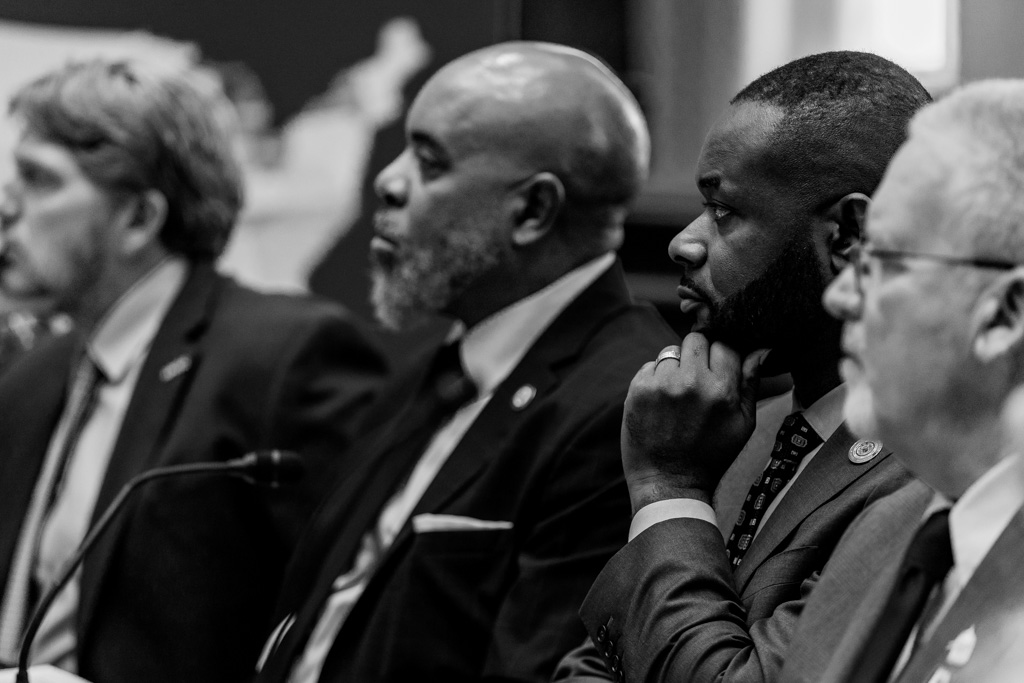
Photo caption: Sen. Cory McCray, a member of Baltimore Local 24, testifies before the Senate Future of the Energy Workforce hearing. Photo shared with permission of photographer Ki Selden of www.defiantshots.com.